

By the Fierce Tennis Editorial Team Fact-Checked for Biomechanical Accuracy
At the elite level of tennis, power is often an illusion. When you watch a professional player launch a 130mph serve, it often looks effortless—liquid, rhythmic, and smooth. Conversely, at the local club, you will see players straining every muscle in their upper body, grunting with maximum exertion, only to produce a serve that barely hits 80mph.
The difference isn’t raw strength. It’s the Kinetic Chain.
In this technical deep dive, we break down the physics and biology of the serve. If you want to add significant velocity to your ball while reducing the risk of rotator cuff injuries, you must stop “muscling” the ball and start “chaining” your movements.
What is the Kinetic Chain Principle?
In sports science, the kinetic chain refers to the coordinated activation of body segments to generate and transfer force. For a tennis player, the “chain” starts at the feet and ends at the tip of the racket.
Think of your body as a series of links. When one link moves, it creates momentum that is passed to the next, progressively heavier or faster link. If one link in the chain is weak, or if the timing is off (asynchrony), the energy “leaks.” To compensate for this leak, players often try to use their arm or shoulder to generate force, which is the primary cause of both power loss and chronic injury.
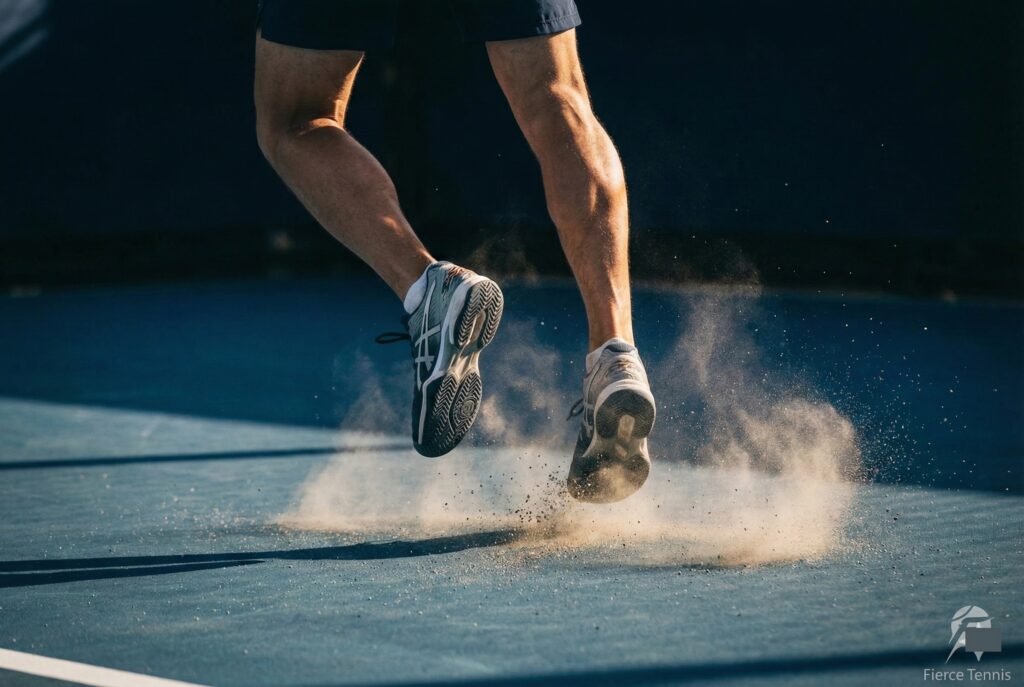
Link 1: Ground Reaction Force (The Engine)
The serve begins where you meet the court. Power does not come from your arm; it is harvested from the ground.
The Loading Phase
As you begin your motion and enter the “trophy pose,” you must engage in a deep knee bend. This is more than just an aesthetic posture; it is an act of eccentric loading. You are storing potential energy in your quadriceps and glutes.
Newton’s Third Law in Action
To go up, you must first push down. Ground Reaction Force (GRF) is the force exerted by the ground on a body in contact with it. The more forcefully you can push into the court during the drive phase, the more energy the ground “returns” to your body. This energy is the “fuel” for the rest of the chain.
Link 2: The Hip and Trunk Rotation (The Transmission)
Once your legs drive upward, the energy must be channeled through your core. This is where most intermediate players fail. They jump, but their upper body remains disconnected from their lower body.
The “X-Factor” Separation
To maximize power, there must be a momentary separation between the rotation of your hips and the rotation of your shoulders. As your legs drive up, your hips begin to turn toward the net while your shoulders remain coiled away from it. This creates a “stretch-shortening cycle” across your obliques and abdominal muscles.
Like a rubber band being stretched to its limit, this torso rotation creates a massive amount of elastic energy that will eventually snap your upper body forward with violent speed.
Link 3: The Racket Drop and Elastic Energy
As the energy moves into the upper torso, we enter the “Racket Drop” phase. This is arguably the most critical moment for technical precision.
The “Whip” Effect
As your chest opens up to the sky, your racket head should drop behind your back. Many coaches call this the “scratch your back” position, but technically, it is the result of external shoulder rotation. The racket should feel heavy and the arm should feel loose. If your grip (the “Death Grip”) is too tight, you create tension in the forearm that acts as a brake on the kinetic chain. The racket drop allows the racket to lag behind the rest of the body, creating a “whip” effect. The longer the path the racket head travels before contact, the more time it has to accelerate.
Link 4: Shoulder Internal Rotation and Pronation (The Release)
We are now at the end of the chain. The energy has traveled from the court, through the legs, into the core, and up the arm. Now, it must be dumped into the ball.
The Science of Pronation
Elite servers do not “push” the ball with their palm. They utilize internal rotation of the humerus (the upper arm bone) and forearm pronation. Just before contact, the forearm rotates so that the palm faces outward away from the body. This is the fastest movement in the human body during any sport. This “snap” isn’t a flick of the wrist; it is the final release of all the accumulated energy from the previous links. If you are missing this, you are likely hitting “flat” serves that have no “bite” or “weight” behind them.
Common “Power Leaks” and How to Fix Them
Our editorial team has identified the three most common ways the kinetic chain breaks down in competitive players:
- The “Waiter’s Tray” Error: This happens when the racket face points toward the sky during the racket drop. This breaks the link between the shoulder and the arm, forcing the player to “push” the ball rather than whip it.
- The “Leaking” Left Arm: If your non-hitting arm (the tossing arm) drops too early, your front shoulder will pull down, causing the energy from your legs to shoot forward into the net rather than upward into the ball.
- Premature Jumping: If you leave the ground before your legs have finished their drive, you lose the Ground Reaction Force. You are essentially trying to fire a cannon from a canoe.
The “Fierce” Training Drill: The Heavy Ball Launch
To feel the kinetic chain without the complexity of a racket, we recommend the Heavy Ball Launch.
- The Drill: Take a 4lb to 6lb medicine ball. Assume your service stance.
- The Goal: Toss the ball over a high fence or a tennis net using a service motion.
- The Insight: You will quickly realize that you cannot throw a heavy ball using just your arm. Your body will naturally find the kinetic chain—you will bend your knees deeper, coil your core tighter, and use the “snap” of your torso to launch the weight.
- The Transfer: Once you feel that “ground-up” power, pick up your racket and try to replicate that same sequence with the much lighter weight of a tennis racket.
Summary: Play Fierce, Not Frantic
The serve is a symphony of moving parts. When you master the kinetic chain, you stop fighting your own body. You stop trying to generate power and start allowing it to happen through proper physics.
Remember: Power is the result of technical efficiency. Spend your next three practice sessions focusing exclusively on the “Link 1” (the leg drive) and “Link 2” (the core coil). Once the foundation of the chain is strong, the speed will follow.