

By the Fierce Tennis Editorial Team Technical Review: Equipment & Sports Science Division
You spent $250 on a graphite frame endorsed by a Grand Slam champion. You spent hours researching swing weight, balance points, and beam thickness. Then, you handed it to a club stringer and said, “Just put whatever in there at mid-range tension.”
You just put regular unleaded gas into a Ferrari engine.
At Fierce Tennis, we believe that equipment is not a fashion statement; it is applied physics. The frame is merely the chassis; the strings are the engine. The interaction between the ball and the string bed during those 4-6 milliseconds of impact determines everything about your shot’s trajectory, rotation, and velocity.
If you are guessing with your tension, you are guessing with your game. Here is the science of what happens when ball meets string, and how to engineer your setup for your specific style of play.
The Mechanics of Impact: The Trampoline Effect
To understand tension, we must understand what happens at contact. When a tennis ball travelling at speed hits a stationary string bed, two things deform: the ball squashes, and the strings stretch.
This interaction creates potential energy. The strings act like a trampoline. They absorb the kinetic energy of the incoming ball by stretching backwards, and then return that energy by snapping back to their original position, launching the ball forward. This is known as the Coefficient of Restitution (COR)—or more simply, the “energy return” of the string bed.
Your reference tension (e.g., 55 lbs) dictates how stiff that trampoline is.
The High Tension Paradox: Why Tighter Equals “Control”
It is counterintuitive for many players: Why does a tighter string bed, which feels harder, offer more control?
When you string at a high tension (e.g., 58+ lbs on a standard 98 sq in head), you are creating a very stiff surface.
1. Reduced Dwell Time
On a tight bed, the strings do not stretch very far back. This means the ball spends less time in contact with the strings (reduced “dwell time”). The ball rebounds almost instantly.
2. The Predictable Launch Angle
Because the strings do not deform significantly, they do not create a deep “pocket” for the ball to sink into. This results in a lower, more linear launch angle. The ball goes exactly where the racket face is pointing at the moment of impact.
The Trade-off: A stiff trampoline doesn’t give you much free energy. You have to bring your own power. If your swing speed is slow, high tension will feel like hitting with a board, resulting in balls landing short. High tension is for players with high-velocity mechanics who need to “tame” their own power.
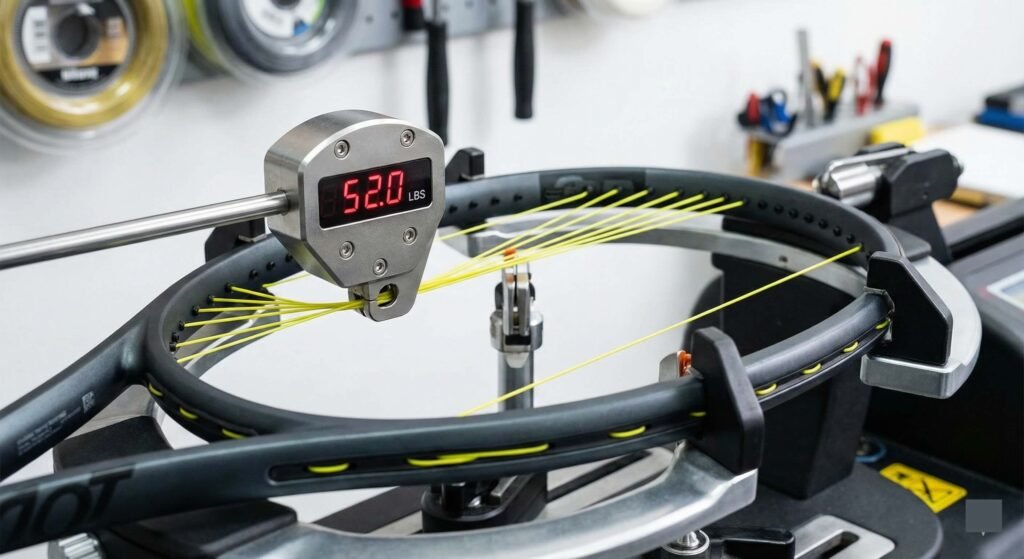
The Low Tension Advantage: Why Looser Equals “Power”
Conversely, dropping tension (e.g., down to 48-52 lbs) loosens the trampoline.
1. Increased Elasticity
When the ball hits a looser bed, the strings stretch further back. This deep deformation stores more elastic energy. When the strings rebound, they return a higher percentage of that energy to the ball. This is “free power.”
2. The “Flyer” Effect
The downside of a deep pocket is that it can be unpredictable. If you hit slightly off-center on a loose bed, the trampoline effect can launch the ball at a higher, sometimes erratic angle. This is why many players feel they “lose control” at low tensions—the ball travels further with less effort, often sailing long if the player doesn’t apply enough topspin to bring it down.
The “Fierce” Application: Modern players are increasingly trending toward lower tensions (even in the 40s) because they use heavy topspin to control the massive power generated by the loose strings.
The Spin Factor: Snapback and Friction
This is where modern tennis diverges from the past. In the era of natural gut, spin was generated primarily by friction—the strings “biting” the felt.
In the modern era of stiff polyester strings (monofilaments), spin is generated largely by Snapback.
The Physics of Snapback
When you brush up the back of the ball for topspin, the main strings (verticals) are pushed sideways, sliding along the cross strings (horizontals). The stored tension then causes the main strings to violently snap back to their original parallel position while the ball is still on the string bed. This snapping action imparts massive torque onto the ball, creating rotation (RPM).
Tension’s Role in Spin
Tension dictates how easily those strings can move.
- If tension is too high, the friction between main and cross strings is too great. They get locked in place and cannot slide, reducing snapback and killing spin potential.
- If tension is too low, the strings move too easily and don’t snap back with enough force.
There is a “Goldilocks zone” for tension where you maximize both string movement and return velocity. For most modern poly players, this is often lower than they think (usually the 48-54 lb range).
The “Fierce” Protocol: Engineering Your Setup
Stop asking your stringer for “what everyone else uses.” Take control of your variables.
1. The Baseline Test
Start at the middle of your racket manufacturer’s recommended range. If the range is 50-60lbs, start at 55lbs. Play with it for at least four hours.
2. The Diagnosis
Analyze your misses.
- Are your balls constantly sailing 2-3 feet long, even when you feel you hit a good shot? Increase tension by 2-3 lbs to lower the launch angle and reduce the trampoline effect.
- Are your balls landing short, or does your arm feel like it’s hitting a brick wall? Decrease tension by 2-3 lbs to open up the sweet spot and gain free depth.
3. The Polyester Adjustment
If you are switching from a soft string (nylon/multifilament) to a stiff polyester, you must drop your usual tension by at least 5-10%. Polyester is naturally stiffer; stringing it at the same tension as nylon will feel unbearably harsh and can lead to elbow issues.
Conclusion: Respect the Science
Your strings are the only part of your equipment that actually touches the ball. You cannot have a “fierce” game if your equipment is working against your mechanics. Understand the physics of the trampoline, respect the mechanics of snapback, and stop guessing. Test, adjust, and weaponize your string bed.