

By the Fierce Tennis Editorial Team Fact-Checked for Biomechanical Precision and Movement Efficiency
In the world of high-performance tennis, we often obsess over the “output”—the velocity of the forehand or the spin rate of the serve. But at Fierce Tennis, we know that every great shot is preceded by a great movement. You cannot fire a cannon from a canoe, and you cannot hit a world-class groundstroke if your feet are stuck in the mud.
The most critical movement in the sport isn’t the sprint to a drop shot; it is the split-step. It is the “reset button” that transforms you from a stationary target into an explosive athlete. However, most club players treat the split-step as a casual hop. In reality, it is a sophisticated plyometric event designed to harvest kinetic energy.
Here is the science of why, how, and exactly when to execute the explosive split-step.
The Physics of the “Pre-Stretch”
To understand the split-step, you have to understand the Stretch-Shortening Cycle (SSC). This is a biomechanical process where a muscle is rapidly stretched (eccentric phase) before it contracts (concentric phase).
Think of a rubber band. If you want to flick it across the room, you first have to pull it back, creating tension. The split-step is the act of “pulling back the rubber band” in your calves, quads, and glutes. When you jump slightly and land with a wide base, your muscles undergo a rapid stretch. This stores elastic energy in your tendons and activates your muscle spindles—sensory receptors that trigger a powerful, involuntary contraction.
By the time you recognize where your opponent has hit the ball, your muscles are already “loaded” and ready to explode toward the target. Without a split-step, you are starting from zero; with it, you are starting from a state of pre-loaded power.
Anatomy of the Perfect Split-Step
A fierce split-step isn’t just a jump; it is a deliberate athletic posture. If executed incorrectly, you actually lose speed. Here are the three non-negotiables:
1. The Wide Base (The Power Platform)
At the moment of landing, your feet should be slightly wider than shoulder-width apart. A narrow base makes you unstable and forces you to take an extra “step-out” to find your balance before moving. A wide base lowers your center of gravity, allowing for an immediate lateral push-off.
2. The Ball-of-Foot Contact
Your heels should rarely touch the ground during a split-step. By staying on the balls of your feet, you keep the Achilles tendon under tension. This is the “spring” of the human body. Landing flat-footed kills your momentum and absorbs the energy into the court rather than reflecting it back into your movement.
3. The Athletic Hinge
As you land, there should be a slight flexion in the ankles, knees, and hips. You aren’t landing “tall.” You are landing in a “ready-to-pounce” position. This slight hinge allows you to utilize the massive power of your glutes and hamstrings to drive your first step.
The Secret is the Timing: The “Reaction Window”
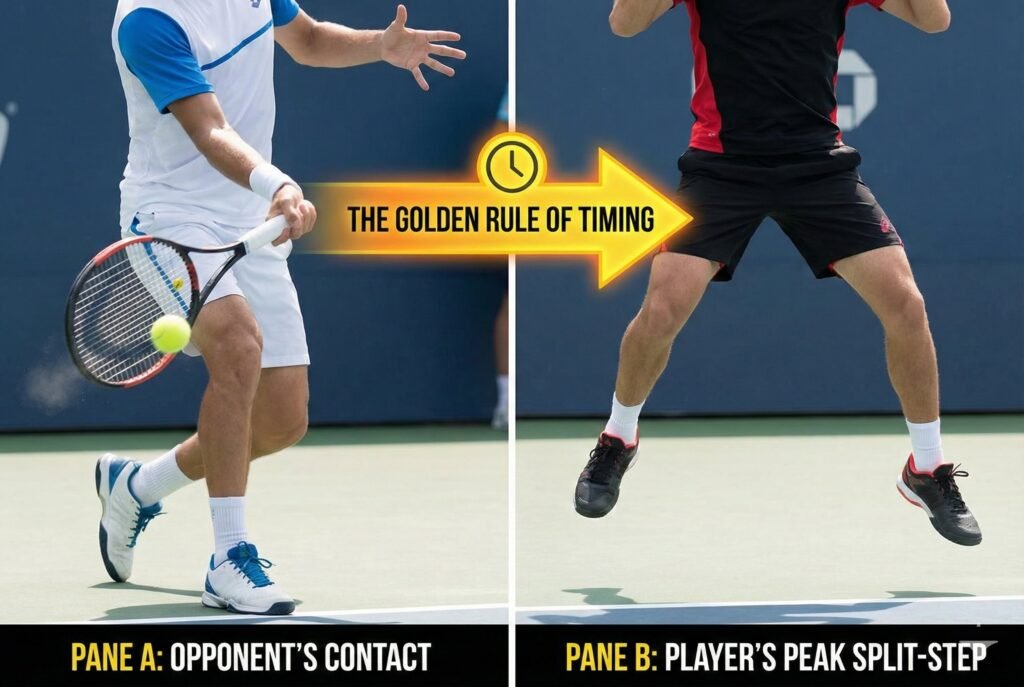
The most common mistake we see is “static timing”—players split-stepping too early or too late. If you land before your opponent hits the ball, the elastic energy dissipates into the ground as heat. If you land after they hit it, you’ve already lost the first 200 milliseconds of the rally.
The Golden Rule of Timing: You should be at the apex of your hop at the exact moment your opponent makes contact with the ball.
- The Launch: Begin your upward spring just as the opponent begins their forward swing.
- The Air Phase: You are in the air as the ball is on their strings.
- The Landing: You land just as you perceive the direction of the ball.
This creates a “weighted” landing where the force of your descent is immediately redirected into your first step. It feels less like a jump and more like “falling” toward the ball with intent.
Deceleration: The Prelude to Speed
The title of this article mentions “deceleration.” Why? Because in a rally, you are often moving back toward the center of the court from a previous shot. To split-step effectively, you must be able to stop your current momentum and “reset” your weight.
The split-step acts as a brake. It neutralizes your previous direction so that you can change course instantly. Professional players don’t just “run” to the ball; they sprint, brake (split-step), and re-accelerate. If you skip the braking phase, you will find yourself “leaning” or “drifting” in the wrong direction, making you vulnerable to wrong-footing.
The “Fierce” Footwork Drill: The Shadow Shadow
To train the subconscious timing of the split-step, we recommend the Shadow Shadow Drill.
- The Setup: Stand on the baseline without a racket. Have a partner stand on the opposite side of the net with a racket and a ball.
- The Action: The partner will shadow-swing (not actually hit the ball) at varying speeds.
- The Goal: You must time your split-step so that you land exactly as their “invisible” contact occurs.
- The Progression: Once your timing is synchronized with their swing, have them actually hit the ball. Your goal is to see how quickly you can “explode” to touch a cone placed 5 feet to your left or right immediately after the landing.
Conclusion: Build Your Game from the Ground Up
You can have the most beautiful strokes in the world, but if you can’t get to the ball in balance, those strokes will fail under pressure. The explosive split-step is the bridge between your fitness and your technique. It is the silent engine of a fierce game.
Next time you hit the court, stop worrying about your follow-through for a moment. Instead, focus on the “spring” in your step. Learn to load the rubber band, time the landing, and turn the court into a launchpad.